
In the rapidly evolving landscape of electronics manufacturing, integrated circuit (IC) programming has emerged as a critical yet often overlooked operational bottleneck. As devices become increasingly sophisticated—incorporating secure boot processes, complex firmware, and ever-expanding memory capacities—the challenge of programming these components efficiently and reliably has never been more pronounced. Manufacturing leaders face a fundamental strategic decision: build internal programming capabilities or partner with specialized service providers.
The traditional view of outsourcing as merely a cost-cutting measure has evolved significantly. In 2025, strategic outsourcing represents a calculated approach to accessing specialized expertise, advanced technology, and operational flexibility that would be prohibitively expensive to develop internally. This comprehensive guide provides engineering managers, procurement specialists, and operations executives with a strategic decision framework for evaluating and implementing outsourced IC programming services.
IC programming, also known as device programming or firmware provisioning, involves loading software code, configuration data, and unique identifiers into semiconductor devices before they are assembled into final products. This process is essential for microcontrollers (MCUs), flash memory chips, secure elements, field-programmable gate arrays (FPGAs), and a wide range of other programmable devices. The stakes are high: programming errors can result in costly board-level failures, product recalls, and damage to brand reputation.
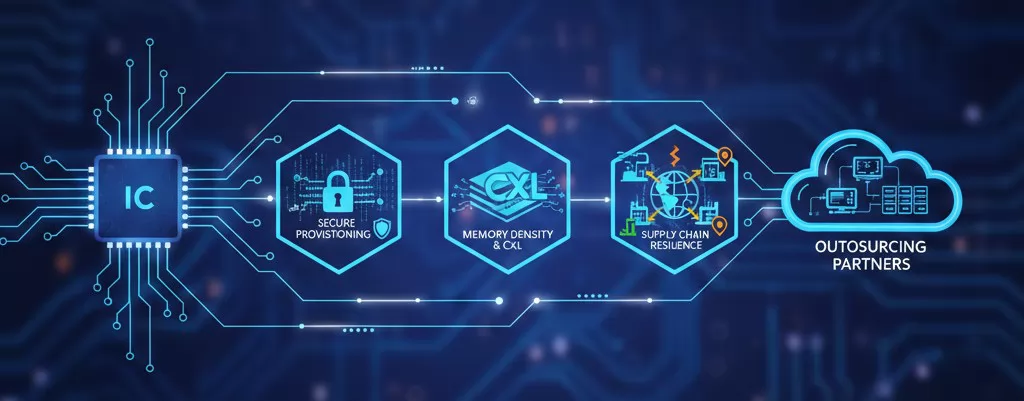
IC programming serves as the critical bridge between semiconductor fabrication and final product assembly. During this process, raw silicon components are transformed into functional building blocks capable of executing specific tasks within an electronic system. The programming process typically involves loading firmware or application code, configuring device settings, and often imprinting unique identifiers for traceability or security purposes.
Modern ICs present increasingly complex programming requirements that challenge traditional in-house approaches. Flash memory densities have grown exponentially, with some devices now requiring programming files measured in gigabytes rather than megabytes. Secure provisioning has become mandatory for IoT devices, automotive systems, and connected electronics, requiring sophisticated cryptographic key management and secure programming environments. Additionally, the proliferation of device types—from traditional parallel NOR flash to advanced Universal Flash Storage (UFS) and embedded MultiMediaCard (eMMC) devices—demands specialized programming algorithms and equipment for each technology.
The programming process itself must meet stringent quality standards. JEDEC standards govern the handling and packaging of programmed devices, while IPC standards ensure quality and consistency throughout the electronics manufacturing process. ESD protection according to ANSI/ESD S20.20 is essential, as electrostatic discharge can irreparably damage sensitive integrated circuits. These requirements create a layered complexity that many manufacturers find increasingly difficult to manage internally.
The financial argument for outsourcing begins with the substantial capital investment required to establish and maintain in-house programming capabilities. Automated Programming Systems (APS) capable of handling modern high-density devices can cost anywhere from $50,000 to over $500,000 depending on throughput requirements and supported device types. Beyond the initial equipment investment, manufacturers must account for ongoing costs including socket replacements, maintenance contracts, software updates, and facility modifications to meet ESD and environmental requirements.
By outsourcing, organizations convert these fixed capital expenditures into predictable operational expenses. The outsourcing model eliminates depreciation schedules, equipment disposal costs, and the risk of technological obsolescence. When next-generation devices require new programming algorithms or higher-speed interfaces, the outsourcing partner bears the burden of equipment upgrades rather than the manufacturer.
Semiconductor technology advances at a remarkable pace, and keeping pace requires continuous investment in programming equipment and expertise. Leading IC programming service providers maintain relationships with semiconductor manufacturers and programming equipment vendors, ensuring they have access to the latest algorithms, socket technologies, and programming protocols before these devices reach mass production.
This technological access proves particularly valuable when working with new device introductions. The time and resources required to develop in-house programming support for a novel device type can delay product launches and consume engineering resources better spent on core product development. Specialized programming partners, by contrast, often have existing support for emerging devices or can develop solutions rapidly due to their focused expertise and established vendor relationships.
Demand variability represents a persistent challenge for electronics manufacturers. Seasonal spikes, product refresh cycles, and unexpected market opportunities create programming volume requirements that fluctuate significantly. Maintaining in-house programming capacity sufficient to handle peak demands inevitably results in underutilization during normal periods—a costly inefficiency that directly impacts profitability.
Outsourcing partners provide inherent scalability that matches programming capacity to actual demand. During peak periods, additional programming resources can be activated without the delays and costs associated with hiring, training, or equipment acquisition. Conversely, during low-demand periods, manufacturers avoid the fixed costs of idle programming capacity. This flexibility proves especially valuable for companies managing multiple product lines with varying lifecycle stages and volume profiles.
First-pass programming yield represents a critical metric that directly impacts manufacturing costs and schedule adherence. Programming failures discovered after board assembly result in costly rework or scrapped assemblies. Professional IC programming service providers typically achieve significantly higher first-pass yields than in-house operations due to their focused expertise, rigorous quality processes, and purpose-built equipment.
Professional programming services implement comprehensive quality assurance processes including 3D coplanarity verification of programmed devices, checksum validation, and functional testing where applicable. Many providers offer value-added services such as laser marking for device identification, tape-and-reel packaging for automated assembly, and serialization for traceability requirements. These capabilities, when developed in-house, require substantial additional investment in equipment and expertise.
Determining the optimal approach to IC programming requires systematic evaluation of multiple factors. The following decision framework provides a structured approach to this strategic assessment.
| Factor | In-House Programming | Outsourced Services |
|---|---|---|
| Initial Investment | High (equipment, sockets, facility) | Minimal (typically none) |
| Per-Unit Cost | Variable (includes labor, overhead) | Predictable, volume-tiered |
| Technology Access | Limited to purchased equipment | Broad, continuously updated |
| First-Pass Yield | Variable (expertise-dependent) | Typically 99.5%+ |
| Scalability | Limited by equipment capacity | Highly flexible |
| Time-to-Market | Longer (setup and debugging) | Faster (existing capabilities) |
| Quality Certifications | Must be independently achieved | Provider certifications apply |
| IP Protection | Full control | Requires partner evaluation |
Manufacturers often underestimate the total cost of in-house IC programming operations. Beyond obvious costs like equipment and labor, consider these factors:
Choosing an IC programming service provider requires thorough evaluation across multiple dimensions. The following criteria should guide your assessment process.
Evaluate the provider's supported device technologies against your current and anticipated requirements. The ideal partner offers broad device support spanning MCUs from multiple manufacturers, various flash memory technologies, and specialized devices like secure elements and FPGAs. Request specific experience with devices similar to those in your product portfolio and inquire about their process for supporting new device types.
Throughput capabilities deserve particular attention. Understanding the partner's programming capacity ensures they can meet your volume requirements while maintaining quality standards. Ask about cycle times for representative device types and their capacity for handling unexpected volume increases.
Quality certifications provide baseline assurance of a provider's operational standards. ISO 9001 certification indicates implemented quality management systems, while IATF 16949 certification demonstrates capabilities meeting automotive industry requirements. For medical device or aerospace applications, additional certifications may be necessary.
Beyond certifications, understand the provider's specific quality processes. Ask about their defect detection methods, traceability capabilities, and handling procedures for sensitive devices. Request data on their historical first-pass yields and understand their escalation process when programming issues occur.
Programming services often involve access to proprietary firmware and sensitive configuration data. Evaluate the provider's security posture thoroughly before sharing intellectual property. Key considerations include facility security access controls, employee background verification, data handling procedures, and contractual provisions for IP protection.
Secure provisioning requirements add additional complexity. For devices requiring cryptographic key injection or secure boot configuration, ensure the partner maintains appropriate security certifications and demonstrated expertise in secure programming methodologies.
Understanding common scenarios where outsourcing IC programming delivers clear strategic advantages helps frame the decision-making process.
Companies producing diverse product lines with individual volumes too low to justify dedicated programming equipment benefit significantly from outsourcing. The per-unit economics of outsourced programming often prove more favorable than the fixed costs of underutilized in-house capacity. This scenario is common among OEMs with extensive product catalogs or companies in early production stages before volume ramps.
When time-to-market pressures demand rapid programming capability for newly released devices, outsourcing partners provide faster access than in-house development. Engineering teams can focus on core product challenges while the programming partner handles device-specific algorithm development and validation.
Products with seasonal demand patterns or significant forecast uncertainty benefit from outsourcing's inherent scalability. Manufacturers avoid the financial impact of programming capacity that sits idle during low-demand periods while maintaining access to additional capacity when needed.
Applications where programming failures carry severe consequences—medical devices, automotive systems, aerospace electronics—often justify outsourcing to partners with demonstrated quality capabilities and appropriate certifications. The cost of a single field failure typically far exceeds programming service fees.

The IC programming landscape continues evolving in response to semiconductor technology advances and changing manufacturing requirements. Understanding these trends helps inform strategic planning.
Secure provisioning has transitioned from specialized requirement to mainstream necessity. As IoT devices proliferate and cybersecurity concerns grow, programming services increasingly incorporate cryptographic key management, secure boot configuration, and device authentication. Partners offering secure provisioning capabilities position themselves to capture growing demand from connected device manufacturers.
Memory density increases continue driving programming complexity. As flash memory capacities grow and new technologies like Compute Express Link (CXL) emerge, programming equipment and processes must evolve accordingly. Outsourcing partners aggregate demand across multiple customers, making investment in advanced programming capabilities more economically viable than individual manufacturers pursuing such investments.
Supply chain resilience has emerged as a strategic priority following global disruption events. Diversifying programming sources across multiple geographies or partners reduces supply chain risk. This trend benefits outsourcing arrangements with established multi-facility providers capable of serving customers from redundant locations.
The decision to outsource IC programming services represents a strategic choice with significant implications for manufacturing operations, cost structure, and time-to-market capabilities. While in-house programming may suit certain high-volume, stable-demand scenarios, the increasing complexity of semiconductor devices and programming requirements favors the specialized capabilities, flexibility, and expertise that outsourcing partners provide.
Success in outsourcing requires thoughtful partner selection, clear communication of requirements, and ongoing relationship management. The framework presented here provides a foundation for systematic evaluation, but every organization's circumstances differ. Consider engaging potential partners in detailed discussions, request references from similar customers, and consider pilot programs to validate capabilities before committing to long-term arrangements.
The ultimate measure of outsourcing success lies in manufacturing outcomes: improved first-pass yields, reduced time-to-market, predictable costs, and freed internal resources focused on core competencies. When evaluated against these criteria, strategic outsourcing of IC programming services often delivers compelling advantages for electronics manufacturers navigating an increasingly complex technological landscape.
Velomax Systems delivers specialized IC programming services designed to enhance manufacturing efficiency and product quality. Our comprehensive capabilities span device programming, secure provisioning, and value-added services for diverse semiconductor technologies.
Request a Consultation
Discover this amazing content and share it with your network!
Your Name*
Your Email*


*We respect your confidentiality and all information are protected.
