
Integrated circuit programming is the core process of writing firmware, configuration data, or other digital information to a programmable integrated circuit so that it can perform its intended function. It is a critical step in the manufacturing of electronic products, including industrial controllers, automotive electronics, consumer devices, embedded systems, and smart hardware. The programming method used depends on the IC architecture, memory technology, package type, programming interface, and production volume. Manufacturers may program standalone ICs before assembly, program devices directly on a PCB through in-system programming (ISP), or use automated programming systems for high-volume production. For electronics manufacturers and procurement teams, choosing an IC programming solution involves more than comparing programming speeds; device compatibility, programming accuracy, verification, handling, throughput, traceability, and production scalability can all deeply affect manufacturing efficiency. This comprehensive guide explains how integrated circuit programming works, the main programming methods and equipment, factors that determine production throughput, common challenges, and how to choose an appropriate IC programming solution.
Inquire Now for Customized IC Programming Solutions
Integrated circuit programming is the process of loading digital information into a programmable IC. Depending on the device, this information may include application firmware, boot code, configuration parameters, security data, or an FPGA configuration file. In simple terms, programming gives a programmable semiconductor the information required to perform its intended function within an electronic product. The programming data is normally prepared by the product or engineering team and transferred to the target IC using a compatible programming interface. After the data has been written, the programmer verifies the result to determine whether the operation was completed successfully.
 Programming_1765182360_WNo_1024d771.webp)
Many programmable ICs are supplied without the final firmware or configuration required by the finished product. Programming therefore connects the semiconductor hardware with the functionality defined by the product design. In production environments, the programming process directly impacts:
As electronic products become more sophisticated, programming requirements become increasingly demanding. Larger firmware images, high-density memory, smaller packages, and high production volumes place rigorous technical demands on programming equipment. For high-volume projects requiring dedicated support, specialized IC Programming Services ensure your hardware achieves maximum output and precise execution without line interruptions.
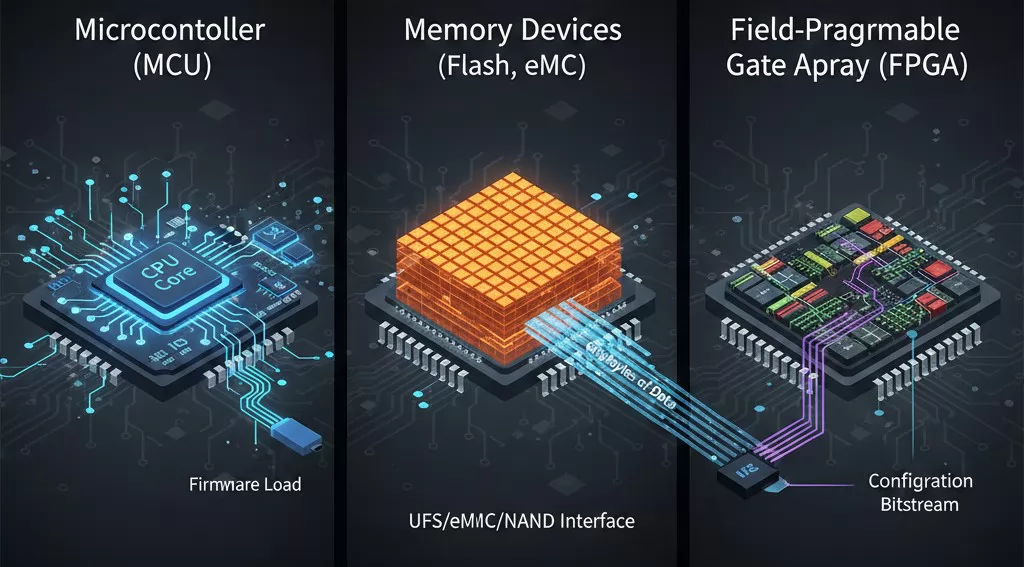
Integrated circuit programming applies to many types of programmable semiconductor devices. The appropriate programming method depends on device architecture, memory technology, communication interfaces, and package constraints.
| IC Type | Typical Programming Data | Common Applications |
|---|---|---|
| Microcontrollers (MCUs) | Firmware and configuration | Industrial, automotive, consumer electronics |
| EEPROM | Configuration and application data | Embedded and control systems |
| NOR Flash | Firmware and boot code | Embedded devices |
| NAND Flash | Firmware and data | Storage and embedded applications |
| eMMC | Firmware and data images | Consumer and embedded electronics |
| UFS | Firmware and large data images | Automotive, mobile, high-performance electronics |
| FPGA/CPLD | Configuration bitstream | Industrial, telecom, computing |
Microcontrollers integrate processing, memory, and peripheral functions into a single device. MCU programming generally involves writing application firmware to internal Flash or another non-volatile memory area. MCUs are widely used in industrial equipment, automotive electronics, appliances, IoT products, and consumer devices.
Flash and EEPROM devices store firmware, configuration parameters, and operational data. Their programming requirements vary according to memory architecture and communication protocols. For Flash devices, programming time increases with data volume, making data size and verification speed critical factors in production planning.
High-density memory devices require significantly more programming data than microcontrollers. eMMC and UFS utilize high-speed interfaces carrying massive firmware files. Manufacturers must utilize an advanced Offline Programmer capable of managing complex protocol handshakes, signal integrity, and massive throughput.
FPGAs and CPLDs are configured using hardware bitstreams rather than conventional application firmware. For an FPGA, a configuration bitstream physically defines the behavior of the internal programmable logic gates. Programming hardware must support the specific target architecture and configuration interface.
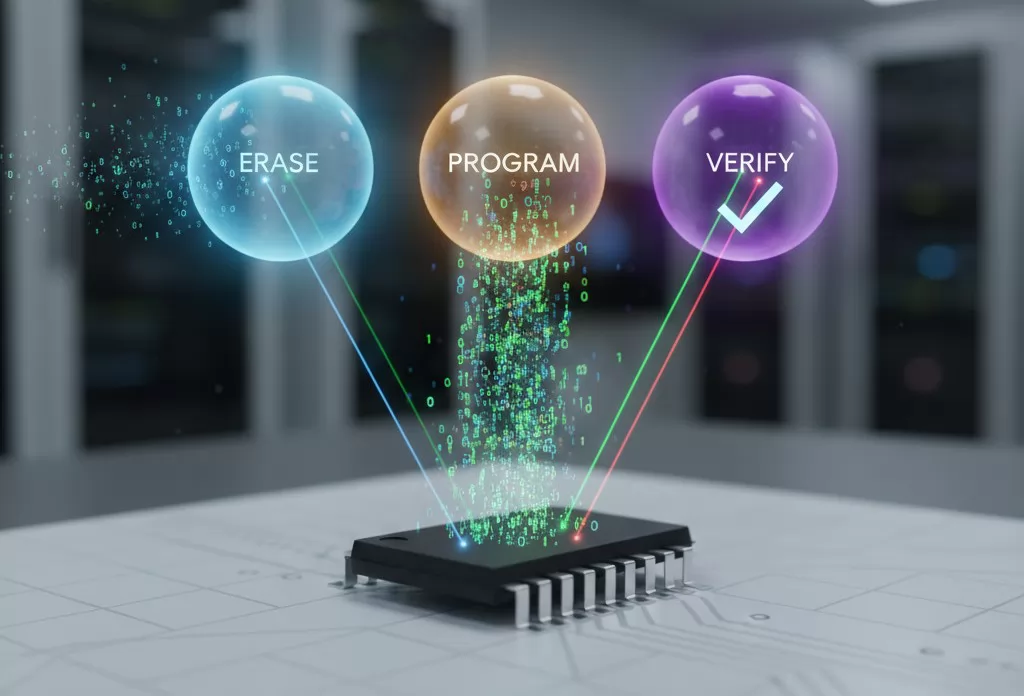
Although procedures vary across device architectures, a standard IC programming workflow follows a multi-stage sequence from data preparation to post-programming logging.
The process begins with the firmware, configuration file, or digital data file to be loaded onto the device. Engineering teams must verify device models, firmware revisions, memory ranges, and security settings before deployment to prevent system-level failures.
The programming system must be configured for the exact target IC. Device selection loads the applicable programming algorithm, operating voltage, pinout mappings, timing parameters, and adapter configurations.
With off-board programming, a standalone IC is loaded into a dedicated programming socket. With ISP, the system connects directly to headers or test pads on an assembled PCB. Clean signal integrity and physical contact reliability are required in both setups.
Many non-volatile memory devices require an Erase operation before writing new data. A subsequent Blank Check confirms that all memory blocks are completely cleared and ready for programming.
The programmer transfers data to the IC through protocols such as SPI, I²C, JTAG, SWD, eMMC, or UFS. Transfer speeds depend on file size, bus clock limits, algorithm optimization, and multi-site parallel configurations.
Verification performs a bit-for-bit check comparing the chip's internal contents against the original source file. This quality gate ensures zero data corruption before the device moves to downstream assembly stages.
Traceability requirements in modern manufacturing demand full logging. Advanced systems record device serials, checksums, operator IDs, timestamps, and pass/fail states into Manufacturing Execution Systems (MES).
Manufacturers select an IC programming method based on where the chip is programmed, how it connects, and required throughput.
Off-board programming processes unmounted, standalone chips using high-speed sockets before PCB assembly. By executing in a controlled electrical environment, off-board systems utilize multi-site parallel programming for rapid batch processing. Explore dedicated hardware choices via our Offline Programmer line.
ISP programs the device after it has been soldered to the PCB. Interface signals are routed through board-level headers or test pins. This eliminates component chip socket handling and enables late-stage firmware flashing. Discover integrated hardware tools using our ISP Programmers.
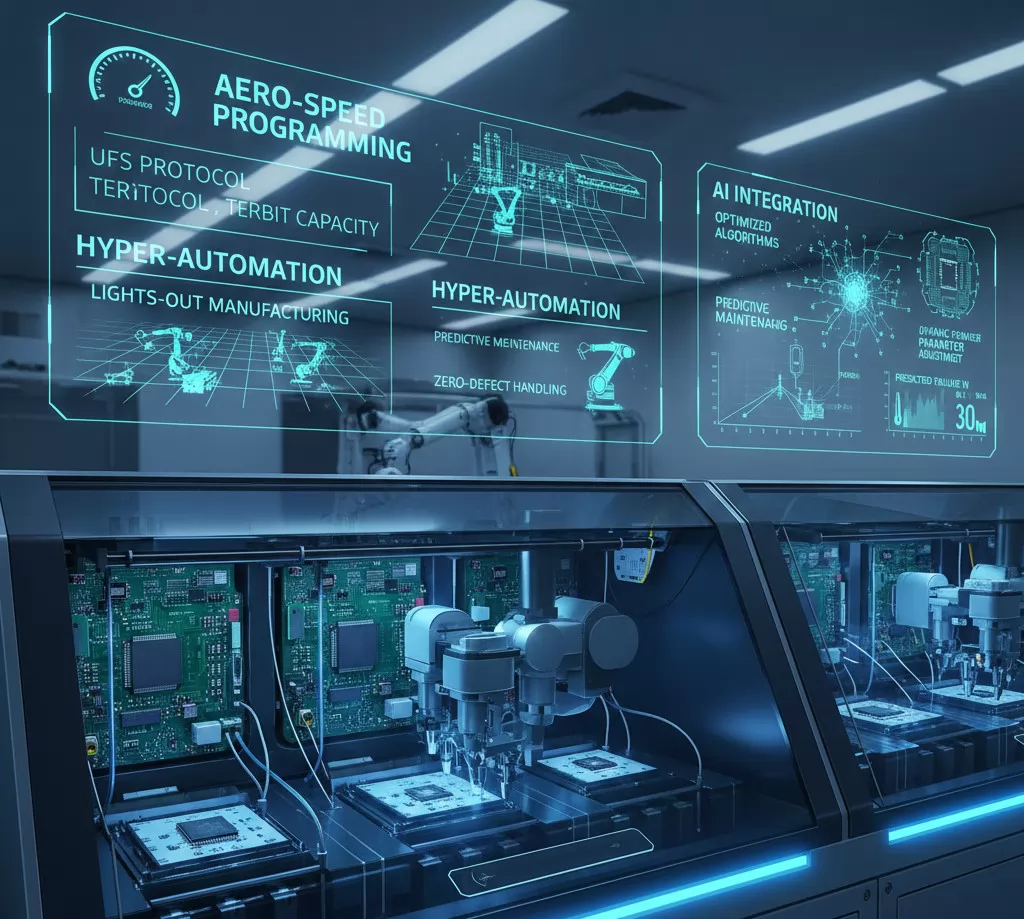
Automated programming integrates high-speed programming hardware with robotic chip pick-and-place mechanisms. Systems handle automated tape/tray feeding, socket loading, optical inspection, marking, and sorting. Learn more about high-throughput automation through our Automated IC Programmers.
| Factor | Off-Board Programming | ISP Programming | Automated Programming |
|---|---|---|---|
| Programming location | Standalone IC | IC mounted on PCB | Automated production system |
| Device handling | Manual or semi-automatic | Limited | Automated |
| PCB access | Not required | Required | Application-dependent |
| Throughput | Medium to high | Application-dependent | High to very high |
| Flexibility | High | High | High at production scale |
| Typical use | Pre-assembly production | Board-level applications | High-volume manufacturing |
Inquire Now for Customized IC Programming Solutions
Offline programmers program standalone chips prior to placement. Utilizing gang-programming sites, they maximize data throughput under controlled signal conditions. Review our full range of Offline Programming Solutions for desktop and benchtop production.
ISP units interface directly with mounted components via edge connectors or bed-of-nails test fixtures. View options via our ISP Programming Solutions.
Fully automated machines unite pick-and-place robotics with multi-site gang programmers to streamline massive production volumes. Explore high-capacity industrial systems using our Automated Main Systems.
While closely linked on the factory floor, programming and testing serve fundamentally different manufacturing roles:
Understanding this distinction is vital when designing an integrated production line that combines programming, optical inspection, functional test, and final packaging.
Programming speed and production throughput are related, but they are not the same metric.
A programmer may transfer data quickly while the overall production cycle remains limited by device loading, socket contact, verification, inspection, or packaging.
Manufacturers should therefore evaluate total cycle time and UPH (units per hour) rather than looking only at raw programming speed
Modern electronics manufacturing introduces several key programming challenges:
Selecting the proper equipment requires systematic evaluation across 8 operational criteria:
Production volume generally dictates the transition from manual setups to full automation:
VeloMax provides end-to-end semiconductor programming solutions engineered for modern manufacturing environments:
Inquire Now for Customized IC Programming Solutions
Integrated circuit programming is the process of writing firmware, configuration data, or other digital information to a programmable IC, allowing the semiconductor to perform its intended function within an electronic system.
A typical IC programming workflow involves file preparation, target device selection, socket or ISP connection, memory erase/preparation, writing data, bit-for-bit verification, and logging results for traceability.
Common programmable devices include microcontrollers (MCUs), EEPROMs, NOR Flash, NAND Flash, eMMC, UFS, FPGAs, and CPLDs.
ISP programs the IC after it is soldered onto a PCB. Off-board programming flashes unmounted, standalone ICs in dedicated sockets before surface mount assembly, offering faster speeds for large files.
Choose a machine by evaluating device part numbers, package formats, programming interfaces, file sizes, mandatory UPH, socket insertion life, software traceability features, and future scalability needs.
Integrated circuit programming is a foundational process point in modern electronics manufacturing, bridging hardware design and firmware execution. Whether managing microcontrollers, high-density memory devices, or complex FPGAs, selecting the optimal programming method, equipment architecture, and verification protocol is essential for maximizing yield and maintaining high operational efficiency. For high-volume manufacturing, advanced automated IC programming solutions minimize handling overhead while ensuring total data integrity. Partnering with VeloMax provides access to industry-leading automated systems, high-speed offline programmers, and flexible ISP setups built to meet the rigorous demands of next-generation hardware production.
Discover this amazing content and share it with your network!
Your Name*
Your Email*


*We respect your confidentiality and all information are protected.
