
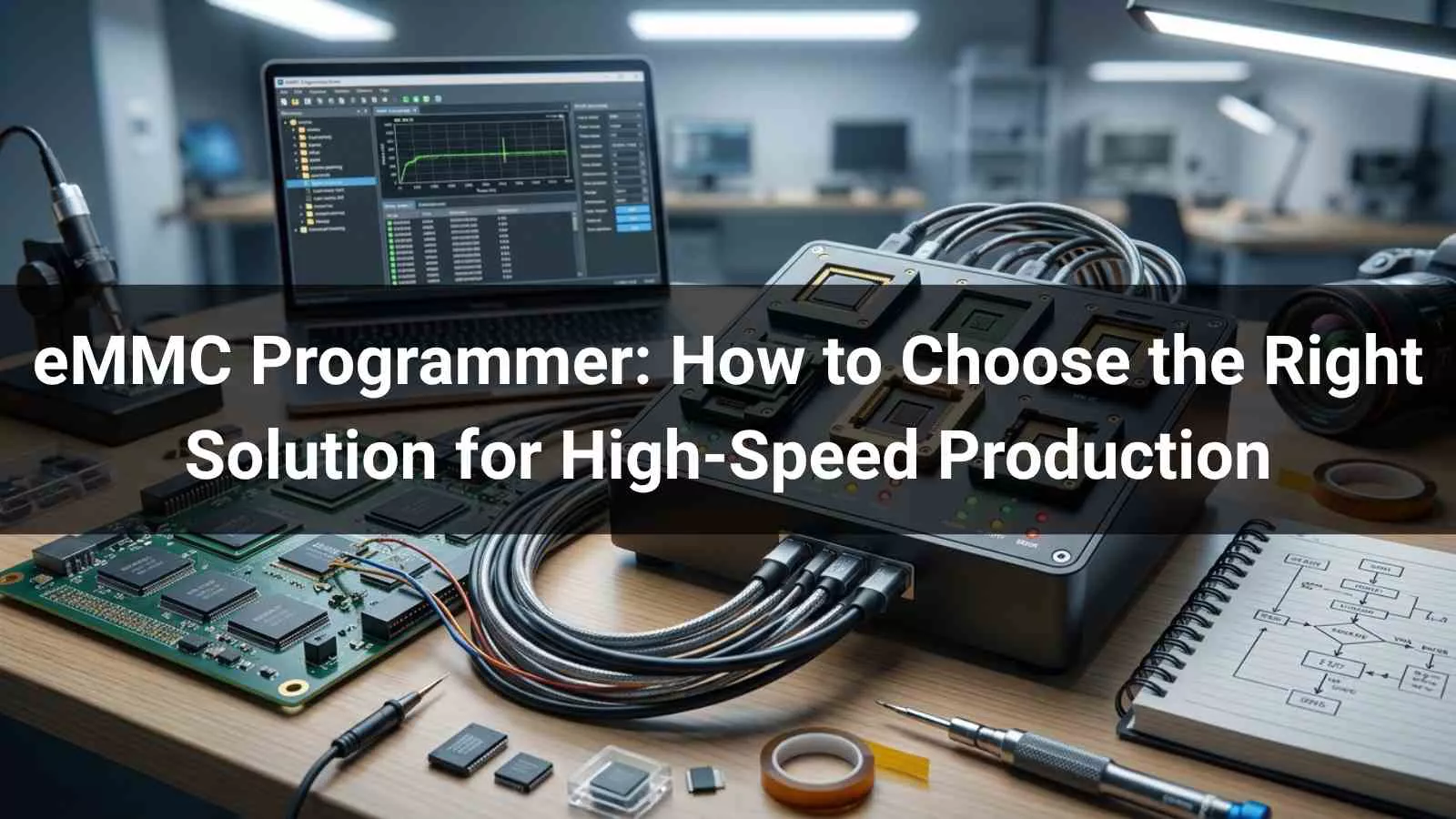
As eMMC-based devices become increasingly common in embedded electronics, consumer products, smart appliances, automotive electronics, and industrial equipment, manufacturers need reliable ways to load firmware and production data onto eMMC devices at scale. Choosing the right eMMC programmer is therefore not simply a matter of finding the highest programming speed.
For production environments, factors such as device compatibility, programming sites, parallel efficiency, verification, software control, traceability, and automation can have an even greater impact on total throughput and cost.
This guide explains how eMMC programmers work, compares the main eMMC programming approaches, and outlines the key factors manufacturers should evaluate when selecting an eMMC programming solution for production.
1. What Is an eMMC Programmer?
2. What Does an eMMC Programmer Do?
3. Why Use a Dedicated eMMC Programming Solution?
4. How Does eMMC Programming Work?
6. Key Factors to Consider When Choosing an eMMC Programmer
7. eMMC Programmer vs. ISP Programmer
8. How Fast Can an eMMC Programmer Program a Device?
9. Choosing an eMMC Programmer by Production Volume
10. VeloMax eMMC Programming Solutions
11. Frequently Asked Questions About eMMC Programmers
An eMMC programmer is a programming device or system designed to write firmware, boot images, configuration data, or other production files to eMMC storage devices.
Unlike general-purpose programming equipment, an eMMC-focused solution must handle the characteristics of high-density managed NAND devices, including their supported interfaces, capacities, packages, programming areas, and production requirements.
A typical eMMC programming process involves connecting the device to a programming interface, loading the required data, transferring it to the eMMC, and verifying that the programmed content is correct.
Depending on the equipment, manufacturers may also be able to manage programming jobs, control multiple devices simultaneously, record production data, and integrate the programmer with automated production equipment or factory systems.
For engineering work, a basic programmer may be sufficient. Production environments are different.
When hundreds or thousands of eMMC devices must be programmed repeatedly, sequential programming can become a bottleneck. A production-oriented eMMC programmer can improve efficiency through multi-site programming, faster data transfer, automated handling, verification, and production traceability.
The objective is not simply to program one device faster, but to achieve a stable and repeatable production cycle.
Although the exact process varies by programmer and device, a typical eMMC programming workflow includes four major stages:
The eMMC is connected to the programmer through a compatible socket, fixture, or production interface.
The required firmware or production image is loaded into the programming system.
The programmer transfers the image to the specified eMMC device areas.
The programmed data is checked, and the result can be recorded for production control and traceability.
For production applications, the programming operation is only one part of the complete cycle. Loading, unloading, verification, device handling, and communication with factory systems can all affect actual throughput. This is why manufacturers should evaluate the entire production process rather than relying on a single advertised transfer-rate figure.
Different production environments require different programming architectures:
A single-site programmer handles one device at a time. It is generally suitable for engineering validation, firmware development, debugging, repair, or low-volume production. Its main advantage is flexibility. When engineers frequently change devices or programming jobs, a single-site solution can be easier to configure and operate. However, sequential programming becomes less attractive as production volume increases.
Multi-site or gang programmers can program several eMMC devices simultaneously. If the programming operation is parallelized effectively, multiple devices can be processed during the same programming cycle. This can significantly increase output compared with a single-site workflow. When evaluating a multi-site programmer, manufacturers should consider more than the number of sockets. Programming speed, site synchronization, device loading time, verification, and actual site utilization all affect real production throughput.
Offline programmers program devices before they are assembled onto the final PCB or system. This approach can be useful when manufacturers want to prepare programmed devices separately from board assembly. It can also simplify production logistics and allow multiple programmers to operate independently. Offline programming is particularly relevant when high-density devices such as eMMC need to be programmed in volume without tying the programming operation directly to a finished board.
Automated programming systems combine programming equipment with material handling and production-control functions. Depending on the system, devices can be automatically loaded, positioned, programmed, inspected, verified, and unloaded. Multi-site programming can further increase throughput. This architecture is most relevant to high-volume manufacturing where manual handling becomes a significant source of labor cost, cycle-time variation, or production bottlenecks.
Selecting an eMMC programmer requires looking at the complete production requirement rather than one specification.
Device compatibility should be the first check. Confirm that the programmer supports the exact eMMC manufacturer, part number, capacity, interface requirements, and package used in production. Package compatibility is particularly important for BGA-based devices because the physical interface and socket configuration must match the device. Do not assume that a programmer supporting one eMMC device will automatically support every eMMC product.
Programming speed is important when firmware images are large or production volumes are high. However, a quoted transfer rate does not necessarily represent the complete production cycle. Manufacturers should also consider verification time, device handling, loading and unloading, and the number of active programming sites. A better metric is the throughput achieved under the actual production configuration.
The number of programming sites determines how many devices can potentially be processed at once. For example, an eight-site programmer can theoretically process eight devices in parallel, but the actual benefit depends on how efficiently all sites are utilized. When comparing equipment, evaluate:
Effective parallel programming can have a much greater impact on production capacity than simply increasing the speed of a single programming channel.
Programming equipment should provide reliable verification to ensure that the required data has been written correctly. Depending on the application, manufacturers may also need error detection, programming-result reporting, and controlled programming-job management. For high-volume manufacturing, consistent verification is especially important because a programming failure discovered later in assembly can result in additional labor, rework, or product-quality issues.
Production programming often involves multiple devices, firmware versions, or product configurations. A suitable programming platform should therefore make it easy to create, manage, and execute programming jobs while reducing the possibility of operator error. Features such as job configuration, device selection, programming parameters, result reporting, and external software control can become increasingly important as production complexity increases.
For connected factories, an eMMC programmer may need to communicate with MES or other manufacturing systems. Integration can allow manufacturers to record programming results, identify failed units, associate production data with specific devices, and maintain a more complete production history. This is particularly valuable for applications where traceability and process control are important.
For high-volume production, programming performance cannot be separated from material handling. If an operator must manually load and unload every device, a fast programmer can still be limited by handling time. Automated systems can reduce repetitive labor and create a more consistent programming cycle. The right level of automation depends on production volume, available labor, equipment layout, product design, and required UPH.
An eMMC programmer and an ISP programmer can both be used for device programming, but they address different production scenarios:
| Factor | eMMC Programmer | ISP Programmer |
|---|---|---|
| Programming location | Usually standalone device | Device installed on PCB/system |
| Typical use | Device-level programming | Board-level programming |
| Production scalability | Strong with multi-site systems | Depends on fixture and board design |
| Device handling | Can use sockets or automated handling | Requires connection to target board |
| Best suited for | Device preparation and production programming | Firmware updates, board testing, and in-system programming |
For manufacturers programming loose eMMC devices before assembly, an offline or multi-site eMMC programming solution may be more appropriate. For deeper insights into board-level programming, read our complete guide on in-system programming vs. offline programming. The decision should be based on the physical production process, not simply the type of memory device.
There is no single programming speed that applies to every eMMC application. Actual programming time depends on factors such as eMMC capacity, image size, programming interface, programmer architecture, verification requirements, number of parallel sites, device handling time, and production configuration.
For this reason, manufacturers should distinguish between data-transfer speed and production throughput. For example, a programmer with a high transfer rate may still deliver limited UPH if loading, verification, or device handling takes a significant amount of time.
A better way to compare systems is to calculate the expected output under the complete production cycle:
Production Throughput ≈ Devices per Cycle × Available Sites ÷ Total Cycle Time
This provides a more realistic basis for comparing eMMC programming equipment.
Production volume is one of the most practical ways to narrow down the required programming architecture:
| Production Requirement | Suitable Approach |
|---|---|
| Engineering or low volume | Single-site programmer |
| Small-to-medium volume | Multi-site or gang programmer |
| Repetitive standalone programming | Offline programmer |
| High-volume manufacturing | Automated programming system |
| Rapidly growing production | Scalable multi-site architecture |
For engineering and low-volume production, flexibility and device coverage may be more important than maximum throughput. As production increases, multi-site programming becomes more attractive because several devices can be processed simultaneously. At very high volumes, automated handling and factory integration can provide additional gains by reducing manual operations and improving process consistency.
Manufacturers should also consider future demand. Selecting equipment solely for current production volume can create another capacity bottleneck when orders increase.
VeloMax develops high-speed programming equipment for high-density devices, including eMMC and UFS applications. Its solutions cover standalone programming as well as automated semiconductor handling systems.
VeloMax's offline programmer lineup includes models supporting eMMC programming and multi-site operation. These systems are suitable for manufacturers that need standalone programming capacity while maintaining flexibility for different production requirements. The platform can also support external ATE systems and software-based control, making it easier to integrate programming into an existing manufacturing workflow.
For production environments where programming time is a bottleneck, VeloMax focuses on high-speed and parallel programming. Its published offline programmer specifications include eMMC programming at up to 100 MB/s for the applicable configuration, with multi-site operation available. Rather than evaluating speed alone, manufacturers should consider how the programmer's transfer rate, number of active sites, verification process, and handling workflow combine to determine actual output.
For higher-volume manufacturing, VeloMax's automated programming systems combine device handling with multi-site programming and production inspection. The AST-1000 supports eMMC programming, up to 16 programming sites, and a rated throughput of up to 1,500 UPH. For larger production requirements, explore the AST-9000 automated IC programming system which supports eMMC and other high-density devices with a published throughput of up to 3,000 UPH.
The appropriate system should be selected according to the exact eMMC part number, package, programming image, required UPH, verification process, and factory integration requirements.
The right eMMC programmer depends on device specifications, image size, throughput target, and factory automation needs. Contact the engineering experts at VeloMax to build an optimized eMMC programming setup for your line.
Discuss Your eMMC Programming RequirementsNo. An eMMC programmer generally programs the standalone eMMC device, while an ISP programmer loads data through a device installed on a PCB or system. The appropriate method depends on the manufacturing process. You can also explore specialized ISP programmers for board-level flashing needs.
There is no single specification. Device compatibility, programming speed, programming sites, parallel efficiency, verification, software control, and production integration should be evaluated together.
Not necessarily. A higher transfer rate does not automatically produce higher production output. Actual UPH also depends on verification, handling, loading, unloading, and site utilization.
Automation is particularly useful when production volume is high, programming is repetitive, manual handling is costly, or manufacturers require consistent production control and traceability.
Start with the exact eMMC devices and packages, required production volume, image size, acceptable cycle time, verification requirements, and factory integration needs. Then compare programming architectures based on total production throughput and long-term capacity.
Choosing an eMMC programmer for production requires more than comparing programming speeds. Manufacturers should evaluate device compatibility, programming sites, parallel efficiency, verification, software control, traceability, material handling, and automation as part of the complete production cycle.
For low-volume applications, a flexible standalone programmer may be sufficient. For larger production requirements, multi-site or automated systems can provide significantly greater capacity and process consistency. By matching the programming architecture to current and future production needs, manufacturers can build a more efficient and scalable eMMC programming workflow with trusted equipment from VeloMax.
Discover this amazing content and share it with your network!
Your Name*
Your Email*


*We respect your confidentiality and all information are protected.
