

As electronic products become more sophisticated, manufacturers need reliable ways to program integrated circuits (ICs) efficiently and consistently. Memory devices, microcontrollers, processors, and other programmable components often require firmware, configuration data, or production files before they can be assembled into finished products. An automated IC programmer can help manufacturers streamline this process by combining device programming with automated handling and production-control functions.
Choosing the right system involves more than comparing programming speed. Device compatibility, programming sites, package handling, inspection, marking, actual units per hour (UPH), software control, and factory integration can all influence production efficiency and product quality.
This guide explains how automated IC programming systems work, compares different programming approaches, and outlines the key factors manufacturers should evaluate when selecting an automated IC programming solution for high-volume production.
- What Is an Automated IC Programmer?
- What Does an Automated IC Programmer Do?
- Why Use an Automated IC Programming System?
- How Does Automated IC Programming Work?
- Types of IC Programming Equipment
- Key Factors to Consider When Choosing an Automated IC Programmer
- Automated IC Programmer vs. Offline Programmer vs. ISP Programmer
- How Fast Is an Automated IC Programmer?
- Choosing an Automated IC Programmer by Production Volume
- VeloMax Automated IC Programming Solutions
- Frequently Asked Questions About Automated IC Programmers
- Conclusion
1. What Is an Automated IC Programmer?
An automated IC programmer is a production system designed to program compatible integrated circuits while automating some or all of the device-handling process. Depending on its configuration, the equipment may load devices, establish electrical contact, write firmware or data, verify programming results, inspect device condition, mark devices, and transfer completed parts to an output carrier.
Compared with a basic manual programmer, an automated system can reduce repetitive operator tasks and help standardize a high-volume workflow. It is especially relevant when manufacturers need to program large quantities of ICs with consistent process settings and traceable production records.
Automated programming equipment is used for compatible devices such as EEPROM, NOR Flash, NAND Flash, microcontrollers, eMMC, and UFS. Actual support depends on the programmer, programming module, package, device algorithm, and software configuration. Buyers should confirm the exact IC part number with the supplier before ordering.
2. What Does an Automated IC Programmer Do?
The exact functions of an automated IC programming system vary by model and installed options. Many systems combine programming hardware with device handling, software controls, and optional inspection or marking functions.
IC Programming and Data Verification
The programming unit writes the required firmware, configuration data, or other supported information to the target IC. Depending on the device and programming process, the system may also perform verification to check whether the written data matches the expected result. The supported algorithms and verification methods should be confirmed for the specific device.
Automated Device Handling
Automated handling moves devices between input, programming, and output positions. Depending on the equipment, devices may be supplied in trays, tubes, tape, or other supported formats. Correct package compatibility and handling accuracy are important for minimizing jams, misalignment, and device damage.
Inspection and Marking
Some systems offer optical inspection, marking, or related process functions. Vision inspection may help identify specified visual defects, while marking can support identification or manufacturing traceability. These functions are configuration-dependent and should not be assumed to be included in every automated programmer.
Repacking and Production Integration
After programming and any required checks, devices may be returned to trays or processed through supported repacking equipment. Some systems can also communicate with manufacturing execution systems (MES) through an API or another interface. Integration requirements should be defined before equipment selection, including the data to be exchanged and the factory systems involved.
3. Why Use an Automated IC Programming System?
Automating IC programming can be beneficial when programming is repetitive, production volumes are increasing, or manufacturers need to coordinate programming with other production steps. The value depends on the existing process and the level of automation required.
Improve Production Consistency
Automated equipment can standardize device movement and programming procedures, helping reduce variation associated with repetitive manual operations. Consistency still depends on correct programming data, compatible devices, validated process settings, and appropriate maintenance.
Reduce Repetitive Manual Handling
Loading, unloading, and transferring individual ICs can consume operator time. Automated handling may reduce these tasks and allow operators to focus on setup, monitoring, quality control, and other production responsibilities.
Support Higher Production Throughput
Multiple programming sites and coordinated handling can increase the number of devices processed during a production cycle. However, actual throughput depends on programming time, device type, verification requirements, handling speed, downtime, and the complete system configuration.
Combine Compatible Process Steps
Where supported, combining programming with inspection, marking, or repacking may reduce separate handling steps and simplify the production layout. Buyers should compare the integrated workflow with the alternative of using separate machines, including the effect on maintenance and changeovers.
Improve Production Traceability
Software controls and supported factory interfaces can help manufacturers manage job settings, programming records, and production data. The specific traceability features vary by system, so required records, user permissions, error handling, and MES communication should be reviewed during the evaluation.
4. How Does Automated IC Programming Work?
Although the sequence varies by machine, an automated IC programming process generally includes job setup, device loading, programming, verification, optional inspection or marking, and output handling.
Step 1: Configure the Programming Job
The operator or production system selects the appropriate device and job configuration, loads the required programming data, and checks relevant parameters. Device part numbers, programming algorithms, data files, and security requirements should be verified before production begins.
Step 2: Load and Position the Devices
Devices enter the machine through a compatible input format. The handling mechanism positions each IC for programming. Package dimensions, orientation, contact requirements, and input carrier compatibility can affect reliability and cycle time.
Step 3: Program the ICs
The programming hardware establishes the required electrical connection and writes the specified data. The process may use multiple active programming sites, depending on the system and device requirements. The number of available sites does not by itself determine the final production rate.
Step 4: Verify and Inspect
Where required and supported, the system verifies programming results and performs additional inspection. Electrical data verification and optical inspection serve different purposes: a successful programming check does not automatically confirm that a device has no visible physical defects.
Step 5: Mark, Sort, or Repack the Devices
Optional functions may include marking, sorting, and transferring devices to an output carrier. The actual sequence depends on the selected configuration and manufacturing process.
Step 6: Record Production Results
Depending on the system's software and integration capabilities, production information may be recorded locally or transferred to a factory system. Manufacturers should confirm which records are available and whether the equipment supports the required MES interface.
5. Types of IC Programming Equipment
Different programming equipment serves different stages of product development and manufacturing. The most appropriate choice depends on output volume, device compatibility, automation needs, and the required production workflow.
Manual IC Programmers
Manual programmers are commonly used for engineering work, prototypes, troubleshooting, repair, and smaller production batches. They can offer flexibility for job changes, but operator handling may limit throughput when quantities increase.
Offline IC Programmers
Offline programming equipment programs ICs separately from their final PCB or target system. Depending on the model, it may support multiple programming sites and batch processing. The term describes a programming approach and does not necessarily mean that the machine is fully automated.
Automated IC Programming Systems
Automated systems combine programming with some level of automatic device handling. Depending on the configuration, they may include input and output handling, multiple programming sites, inspection, marking, repacking, and software integration. They are generally considered when repetitive production and reduced manual handling are important.
ISP Programmers
In-system programming (ISP) allows a compatible IC to be programmed while it remains installed on its target PCB or system. This method is useful when the device, board design, and programming interface support it. ISP requirements differ from those of equipment that handles individual packaged ICs.
Programming Services
For some manufacturers, outsourcing IC programming can be an alternative to purchasing equipment. The decision should account for order volume, turnaround time, intellectual property protection, logistics, quality requirements, and the long-term cost of external services.
2727_1793261095_WNo_1600d900.webp)
6. Key Factors to Consider When Choosing an Automated IC Programmer
Selecting an automated IC programmer requires evaluating both the target devices and the production environment. The following factors can help manufacturers prepare a practical equipment specification before requesting quotations.
Device and Package Compatibility
Confirm the exact IC part numbers, package types, dimensions, pin arrangements, and programming interfaces. Broad device-category support does not guarantee that every device within that category is compatible with a particular system.
Programming Requirements
Identify the required programming algorithms, data-file formats, image sizes, security functions, and verification steps. Large data images or device-specific programming sequences can affect cycle time, so testing should use representative production data.
Throughput and Active Programming Sites
Compare published UPH figures carefully and ask how they were measured. Relevant conditions include the device type, data size, number of active sites, handling sequence, verification, and any inspection or marking steps. Maximum published throughput should not be treated as a guaranteed production rate.
Input and Output Handling
Check the supported tray, tube, tape, or other carrier formats. Also review loading capacity, output requirements, changeover procedures, and the way the machine handles rejected or failed devices.
Inspection and Marking Options
Determine whether the process needs optical inspection, marking, sorting, or repacking. Confirm the supported inspection methods, marking technology, data requirements, and whether each function is standard or optional.
Software and MES Integration
Define the required job management, user access, production records, error reporting, and factory communication. If MES integration is required, confirm the supported interface, data fields, and responsibilities for integration and validation.
Maintenance and Technical Support
Ask about preventive maintenance, consumable parts, programming socket replacement, software updates, operator training, troubleshooting, and service response. These factors can affect the equipment's long-term availability and total cost of ownership.
Expansion and Total Cost of Ownership
Evaluate purchase price alongside installation, training, tooling, maintenance, software, consumables, downtime, and future expansion. A system that meets current demand may become a bottleneck if product mix or output requirements change.
7. Automated IC Programmer vs. Offline Programmer vs. ISP Programmer
These terms describe different aspects of IC programming and are not always mutually exclusive. An automated IC programming system may incorporate offline programming hardware and automated handling in the same platform. ISP programming, by contrast, refers to programming a compatible device while it remains connected to its target board or system.
| Comparison Item | Automated IC Programmer | Offline Programmer | ISP Programmer |
|---|---|---|---|
| Typical Programming Location | Usually handles packaged ICs in a production system | Programs ICs separately from their final board or system | Programs a compatible IC while it remains on the target board or system |
| Handling Automation | Automated handling is a core feature, depending on configuration | May be manual or automated, depending on the equipment | Depends on the fixture, board-handling setup, and production process |
| Common Use Cases | Repetitive and higher-volume IC production | Engineering, batch programming, and production workflows | Board-level programming, firmware updates, and supported manufacturing processes |
| Throughput Considerations | Depends on active sites, programming time, handling, and optional process steps | Depends on site count, operator workflow, and programming time | Depends on interface speed, board access, fixtures, and programming requirements |
| Key Selection Factor | Device compatibility and complete production workflow | Device coverage and batch-processing needs | Board design, device support, and access to the programming interface |
These approaches are not always mutually exclusive. An automated IC programming system may incorporate offline programming hardware and automated handling in the same platform. The correct choice depends on where the IC is programmed, how devices enter and leave the process, and the required production capacity. For more information about board-level programming, read the VeloMax guide to ISP programmers.
8. How Fast Is an Automated IC Programmer?
There is no single production speed that applies to every automated IC programming application. Actual performance depends on device type, image size, programming interface, number of active sites, verification requirements, handling time, and the configuration of the complete system.
Manufacturers should distinguish between programming transfer rate and production throughput. Transfer rate describes how quickly data moves under specified conditions. UPH measures how many devices the production process completes in an hour. A high transfer rate does not necessarily mean that the entire production line will achieve a proportionally higher output.
For a preliminary estimate, manufacturers can use the following simplified relationship:
Estimated Theoretical UPH = Devices Completed per Cycle × 3,600 ÷ Cycle Time in Seconds
For example, if a system completes 8 devices in a 12-second cycle, its theoretical output would be 2,400 devices per hour under those assumed conditions. This is an illustrative calculation, not a specification for a particular machine. Real output may be lower because of loading variation, downtime, changeovers, device failures, or other production constraints.
When comparing suppliers, ask for a production trial using the actual IC part number, programming data, package, and required process steps. This provides a more useful estimate than comparing headline speeds alone.
9. Choosing an Automated IC Programmer by Production Volume
Production volume is a useful starting point when choosing a programming architecture. The right system should also reflect device complexity, product mix, handling requirements, quality expectations, and the expected growth of the manufacturing operation.
| Production Requirement | Potentially Suitable Approach | Main Consideration |
|---|---|---|
| Engineering and Prototypes | Manual programmer or flexible programming station | Device coverage and easy job changes |
| Low-to-Medium Volume | Offline or multi-site programmer | Parallel capacity and operator workflow |
| Repetitive Production | Multi-site programming system | Cycle time, site utilization, and repeatability |
| High-Volume Manufacturing | Automated IC programming system | UPH, automated handling, inspection, and integration |
| Growing Production Demand | Scalable automated platform | Expansion options and long-term capacity planning |
For engineering and low-volume applications, flexibility and broad device support may be more important than maximum throughput. As production becomes more repetitive, multi-site programming can help increase capacity. For high-volume operations, automated handling and integrated inspection or marking may further reduce manual steps.
Manufacturers should also consider product changes and future demand. A system that meets today's volume may become a bottleneck if new device types, larger programming images, or higher order quantities are introduced. Evaluating expansion options early can help reduce the risk of investing in equipment that cannot accommodate future requirements.
10. VeloMax Automated IC Programming Solutions
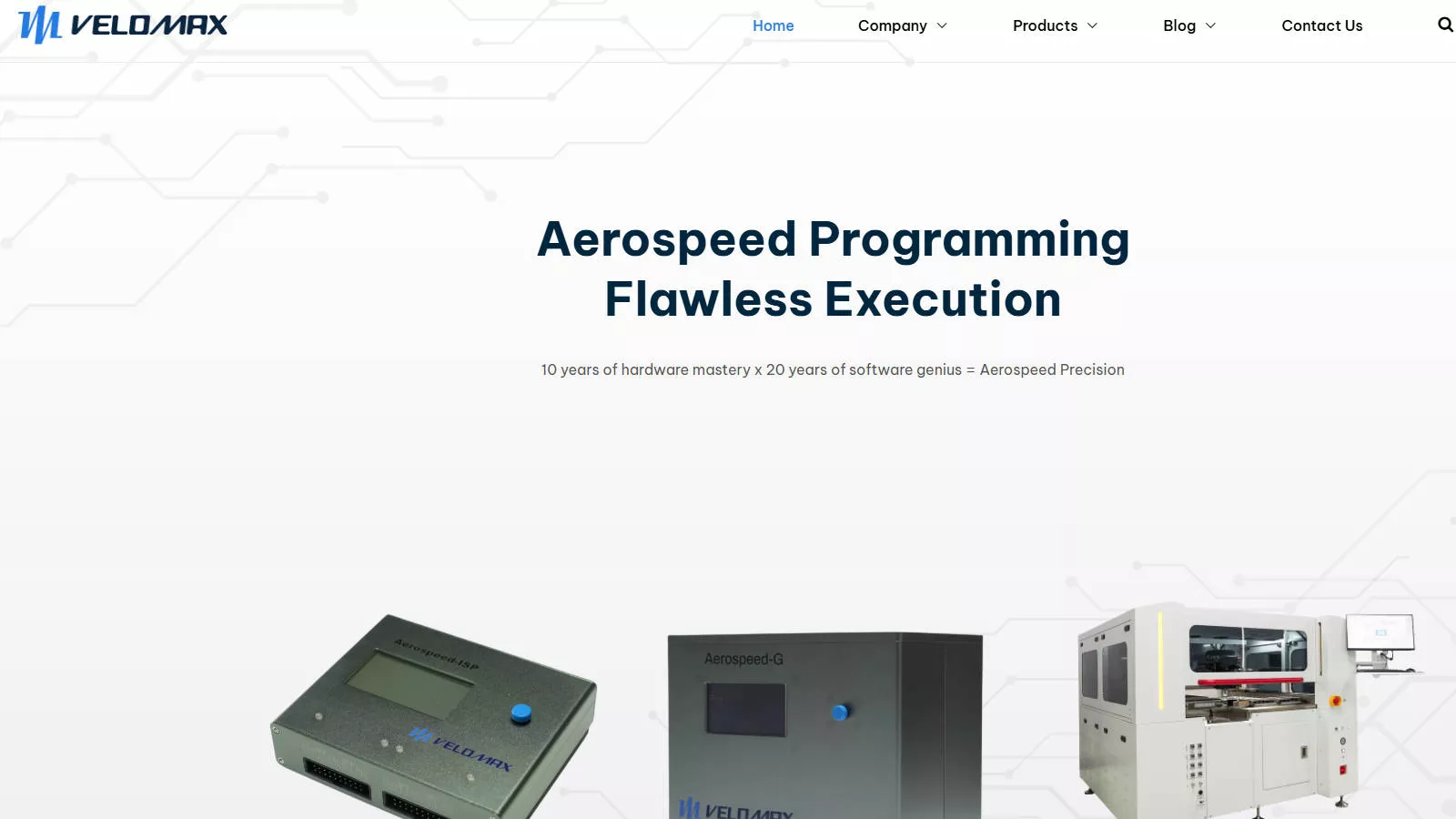
VeloMax develops IC programming equipment and automated semiconductor handling solutions for engineering, production, and high-volume manufacturing applications. Its product range includes automated main systems, automated handlers, offline programmers, manual programmers, ISP programmers, and programming services.
VeloMax's automated systems can combine programming with functions such as 2D/3D inspection, marking, and repacking, depending on the selected model and configuration. Supported device categories include EEPROM, NOR/NAND Flash, MCU/MPU, eMMC, UFS, and other programmable IC types. Manufacturers should confirm specific device, package, and process compatibility with the supplier before selecting a system.
AST-1000 Automated IC Programming System
The VeloMax AST-1000 is designed for automated programming of high-density memory and microcontroller devices. Its integrated functions can include programming, inspection, marking, and repacking, helping manufacturers coordinate several production steps in one system.
Published specifications list throughput of up to 1,500 UPH, up to 16 programming sites, and XY positioning accuracy of ±0.02 mm. Supported device categories include EEPROM, NAND/NOR Flash, MCU, eMMC, and UFS, with compatible packages depending on the configuration. The system also supports software features such as quick setup, error-prevention functions, and MES integration via API.
AST-1000 may be worth evaluating for manufacturers that need automated handling and integrated programming functions without requiring the highest published capacity in the AST range. Actual performance should be confirmed using the target device and production workflow.
AST-3000 Automated IC Programming System
The AST-3000 automated IC programming system is another option in VeloMax's AST series. Published product information lists throughput of up to 2,800 UPH and up to 64 programming sites. The system is positioned for production applications involving devices such as UFS, eMMC, NAND Flash, and MCUs, subject to device and configuration compatibility.
When evaluating the AST-3000, manufacturers should review the required IC packages, programming modules, output format, inspection requirements, and target cycle time. These details help determine whether its capacity and configuration are appropriate for the intended production line.
AST-9000 Automated IC Programming System
The VeloMax AST-9000 is designed for high-density IC programming and higher-volume production. Its published functions include automated programming, 2D/3D inspection, marking, and repacking. Depending on the configuration, the system can use multiple programming units and input/output peripherals to support a coordinated production workflow.
VeloMax lists maximum throughput of up to 3,000 UPH and up to 64 programming sites for the AST-9000 product configuration described on its product page. Supported device categories include EEPROM, NAND/NOR Flash, MCU/MPU, eMMC, UFS, and other programmable ICs. Available package formats and peripheral options should be verified for the specific project.
The system also lists software features such as quick setup, reprogramming settings, double-feed prevention, unique-key customization, and MES integration via API. These functions can be relevant to manufacturers seeking to combine high throughput with automated handling and production control.
How to Select the Right VeloMax Configuration
The appropriate system depends on more than the target UPH. Before requesting a quotation, manufacturers should prepare the exact IC part numbers, package types, programming files or image sizes, required verification steps, expected daily output, and preferred input/output carriers. It is also helpful to specify whether the process requires optical inspection, marking, repacking, or MES integration.
| VeloMax System | Published Maximum Throughput | Published Maximum Programming Sites | Typical Evaluation Focus |
|---|---|---|---|
| AST-1000 | Up to 1,500 UPH | Up to 16 | Automated programming and integrated handling |
| AST-3000 | Up to 2,800 UPH | Up to 64 | Higher production capacity and multi-site programming |
| AST-9000 | Up to 3,000 UPH | Up to 64 in the referenced product configuration | High-volume production and integrated process functions |
The figures above are published maximum specifications, not guaranteed production output for every device. Actual UPH and available site configurations depend on the selected system, IC type, programming requirements, and production setup. Confirm the final configuration and expected performance directly with VeloMax.
Need an Automated IC Programming Solution?
The right automated IC programmer depends on your target ICs, package formats, programming requirements, production volume, and factory integration needs. Contact VeloMax to discuss your application and identify a suitable programming configuration.
11. Frequently Asked Questions About Automated IC Programmers
What is an automated IC programmer?
An automated IC programmer is a system that programs compatible integrated circuits while automating some or all of the device-handling process. Depending on the model, it may also integrate inspection, marking, sorting, repacking, and production software functions.
Which IC types can an automated IC programming system support?
Support varies by programmer and configuration. Common categories may include EEPROM, NOR Flash, NAND Flash, MCU, MPU, eMMC, UFS, FPGA, and CPLD. Always confirm the exact device part number, package, and programming requirements with the equipment supplier.
What does UPH mean in automated IC programming?
UPH means units per hour and describes the number of devices processed in one hour. The actual result depends on programming time, active sites, handling, verification, inspection, changeovers, and production availability. A published maximum UPH should not be treated as a guaranteed rate for every device.
Is an automated IC programmer better than a manual programmer?
It depends on the application. Manual programmers can be suitable for prototypes, engineering, repair, and small batches. Automated systems are generally more relevant when programming is repetitive, production volumes are higher, or integrated device handling and inspection are required.
What is the difference between an automated IC programmer and an ISP programmer?
An automated IC programmer focuses on automating device programming and related production steps, usually for devices handled separately from the final PCB. An ISP programmer programs a compatible IC while it remains connected to its target system or board. The appropriate method depends on the IC, its programming interface, and the manufacturing process.
Can an automated IC programmer inspect and mark devices?
Some systems integrate vision inspection and marking functions, but the available capabilities depend on the model and installed options. Manufacturers should confirm supported inspection methods, marking technologies, and process requirements before selecting a system.
Does an automated IC programming system support MES integration?
Some systems provide MES integration through an API or another supported interface. The available functions and data fields vary, so manufacturers should define their traceability and communication requirements during the equipment-selection process.
How do I choose an automated IC programmer for mass production?
Start by identifying the target ICs, package types, programming files, verification requirements, required UPH, and input/output formats. Then evaluate the number of programming sites, automated handling, inspection, marking, software controls, MES integration, maintenance support, and expansion options. A production trial using representative devices can help confirm expected performance.
What information should I provide when requesting a quotation?
Provide IC part numbers, package types, required programming data, expected production volume, target UPH, verification and inspection requirements, input/output carrier formats, marking needs, and any MES or factory integration specifications. These details help the supplier recommend a configuration that fits the application.
12. Conclusion
Choosing an automated IC programmer requires more than comparing maximum programming speeds. Manufacturers should evaluate device compatibility, package formats, programming sites, actual UPH, verification, automated handling, inspection, marking, software control, and factory integration as parts of the complete production process.
Manual and offline programmers may be appropriate for engineering or lower-volume applications, while automated systems can provide a more integrated approach for repetitive, high-volume manufacturing. The best solution is the one that matches the target ICs, production workflow, quality requirements, and future capacity plans.
With options including AST-1000, AST-3000, and AST-9000, VeloMax provides automated IC programming systems for a range of production requirements. Review the required device specifications and process conditions with the supplier to identify the appropriate configuration for your manufacturing line.


